Goat Vector Design: A Practical Embroidery Review
As a designer who’s stitched hundreds of custom pieces—from boutique aprons to Etsy baby onesies—I opened Goat Vector Design expecting charm, but what I found was something more useful: clarity. Not just visual clarity, but functional clarity—the kind that tells you instantly whether a design will translate cleanly from screen to thread, fabric to finished product.
First Impressions: Whimsy with Structure
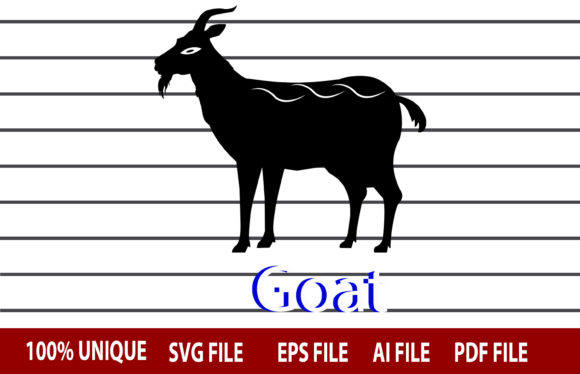
The Goat Vector Design lands with gentle confidence—not cartoonish, not overly stylized, but warmly illustrative. Its silhouette is clean and balanced, with subtle curvature in the horns and a soft contour around the face that avoids rigidity. There’s no tiny facial detailing (no pupils, no nostril lines), which immediately signals smart scalability. That absence isn’t a flaw—it’s foresight. In embroidery, less often means *more*: better stitch definition, fewer thread breaks, and smoother satin stitch flow across curves.
I pictured it right away on a natural linen tote bag for a local farm-to-table shop—simple, earthy, quietly memorable. It wouldn’t shout. It would invite a second look. And that’s where this design earns its keep: in handmade product contexts where authenticity and restraint build trust.
Where It Shines in Real Embroidery Projects
Goat Vector Design works exceptionally well for sweatshirt embroidery and tote bag design—especially when paired with medium-weight cotton or canvas. Its open negative space allows fill stitch to breathe, reducing puckering risk on denser fabrics. On baby embroidery—think organic cotton burp cloths or knit rompers—the shape reads clearly even at 3–4 inches wide, and the lack of fine interior lines means no lost detail in small hoop sizes.
It’s also a quiet standout for holiday embroidery and personalized gifts. Imagine it stitched in ivory thread on a charcoal wool blanket for a rustic nursery, or as an embroidered patch on a denim jacket for a craft fair vendor. Because it’s built as a vector (Ai, EPS, SVG, PDF), resizing for different applications—caps, pillow covers, tea towels—is predictable and distortion-free. No pixelation, no jagged edges when scaling down for a child’s cap brim or up for a large wall banner.
For Etsy sellers and small shop owners, this is a versatile digital embroidery file that supports brand consistency without demanding heavy customization. You can pair it with a simple sans-serif font for a cohesive label or leave it standalone as a signature motif—ideal for shops centered around farms, homesteading, sustainable living, or gentle humor.
Where to Proceed Thoughtfully
While Goat Vector Design is forgiving by nature, it still asks for intention. On stretchy fabric like jersey or thin knits, always use cutaway stabilizer—its smooth outer curve can pull if unsupported. On dark fabric, test thread colors first: light ecru or oatmeal may read softer than expected; a warm cream or heather grey often delivers richer contrast without harshness.
Avoid cramming it into tiny hoops (<3 inches) unless you’re willing to simplify further—those gentle horn curves tighten into potential density traps. Likewise, curved surfaces like caps require careful digitizing adjustments (which this vector doesn’t include—it’s a graphic, not an embroidery file). If you’re using it for commercial embroidery, confirm whether your digitizer can adapt it efficiently for stitch types like satin stitch along the outline and low-density fill stitch within the body.
And while it’s labeled for use on mugs, mouse pads, and stickers—that’s great for print—but remember: those applications don’t translate directly to thread. What reads crisply as a cut file may need reworking for dense stitch areas or tight corners in machine embroidery design. Always treat it as a starting point, not a final stitch file.
Design Judgment in Action: A Real Tote Bag Test
Last week, I prepped Goat Vector Design for a client’s limited-run linen tote—intended as wedding favors for a goat farm venue. I resized it to 4.2 inches wide, ran a quick printable mockup, then stitched a sample on scrap fabric using 40-weight rayon. The result? Clean outlines, zero skipped stitches, and a shape that held personality without looking “busy.” Customers noticed it—not because it was loud, but because it felt *considered*. That’s the difference between decoration and design.
It also performed well under washing tests—no fraying, no thread migration—thanks to its generous line weight and minimal internal detail. That matters for kitchen towels, baby items, and anything meant to live beyond first use.
Practical Notes Every Embroidery Designer Should Keep Handy
- Always test on scrap fabric matching your final garment’s weight and stretch.
- Check stitch density before production—especially where curves meet straight edges.
- Confirm hoop size compatibility; this design scales well, but digitizing for under-3-inch hoops requires refinement.
- Inspect small details at actual stitch size—what looks fine on screen may vanish in thread.
- Try black-and-white mockups to assess contrast on both light and dark backgrounds.
- Use appropriate stabilizer: cutaway for knits, tear-away for stable wovens, fusible for lightweight linens.
- Verify licensing before selling finished products or digital embroidery files—this is a Graphics asset, not pre-digitized embroidery.
For craft business owners, Goat Vector Design isn’t just another Illustrations download—it’s a reliable visual anchor. It supports storytelling without overshadowing the product, adds warmth without clutter, and scales with your growth—from first-time hobbyist to full-time Etsy seller. It won’t solve every challenge, but it removes several common ones: ambiguity, overcomplication, and visual fatigue. And in the world of handmade product and personalized gift making, that kind of clarity is rare—and valuable.